


My daughter has just finished her second week of Kindy and she’s already telling us she loves it, which is the kind of thing that makes all the admin from last year feel worth it. A few friends have asked how we actually worked out which school we were zoned for, and then how we ended up somewhere we technically weren’t, so I figured it was worth writing the whole thing down properly.
How to Check Your Catchment
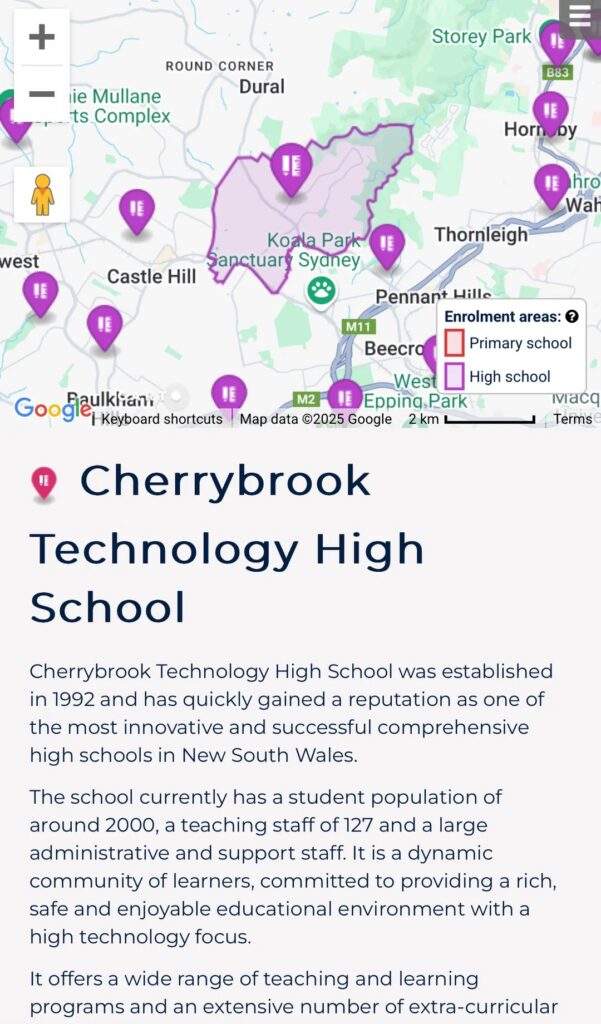
If you just want to know which school your address belongs to, the quickest way is the NSW Department of Education’s own School Finder tool. You search by suburb or address, choose primary or high school, and it shows you your local enrolment area on a map along with the school’s contact details and other basics. Real estate sites like Domain and some property listing pages will also show you the local school zoning if you punch in an address, which is handy if you’re comparing a few properties before you commit to one.
I used to assume catchments were split cleanly along roads, like everyone on one side of a street belongs to School A and everyone on the other side belongs to School B. Turns out that’s not always true. Catchment boundaries can run in odd shapes and don’t always line up with what feels like the obvious dividing line, especially in older suburbs, so it’s worth checking your actual address rather than assuming based on a neighbour’s experience or a general sense of “that side of the highway.”
One more thing worth knowing: your primary school catchment and your high school catchment for the same address aren’t necessarily linked to the same boundary, so if you’re planning years ahead, check both separately rather than assuming the high school will just be “whichever one is closest.”
Applying Out of Area: What Actually Happened for Us
We weren’t in our first-choice school’s catchment, so we went ahead and lodged an out-of-area application anyway. Three weeks later we were rejected, which wasn’t a huge surprise given the zoning. What the teacher told us at the time stuck with me though: even without a confirmed place, because we were planning to move into the area, we were still welcome to bring our daughter along to the final term’s four-week orientation sessions.
So that’s what we did. In November we brought her in for a two-hour session each week, and while the kids settled into a taste of classroom life, the school ran a parent info session alongside it covering how the school actually runs day to day, what to prepare before starting, and how to support your child’s early learning at home. It was a genuinely full program, not just a token morning tea.
The turning point came in the first week of that program. The principal spoke to the group of parents and mentioned the school was expanding its intake, and encouraged anyone with friends or family who might be interested to put in an application. I went and asked directly whether we could apply out of area given that. The response was warm, essentially “please do.” We submitted the application that weekend, and by early the following Tuesday morning we had an acceptance email in our inbox. Then it was just a matter of getting the paperwork together.
The Address Check Isn’t Just for In-Catchment Families
Here’s the bit that actually surprised me most. I’d assumed the 100-point residential address check was only something in-catchment families had to worry about, since the whole point seemed to be proving you live where you say you live. It turns out out-of-area students go through the same address verification, the difference is simply that your address doesn’t need to fall inside that particular catchment for it to count.
We didn’t have the higher-value documents like a lease agreement or a council rates notice to put toward it, since we were still transitioning into the area, but between car registration, insurance paperwork and a phone bill in our name, we got close enough to what the school needed. If you’re in a similar spot, it’s worth asking your chosen school early what specific documents they’ll accept and how the points break down, since schools can vary slightly in what they ask for and thresholds shift depending on how close a school is to capacity.
If you’re mapping this out around when your child will actually start, our NSW School Holidays 2026 page has the full term dates, which is worth bookmarking alongside whatever school search you’re doing, since kindergarten orientation sessions tend to run in the final term before your child starts.
School catchment and enrolment information above reflects current policy on the NSW Department of Education’s School Finder and enrolment pages at time of writing. Requirements and catchment boundaries can change, so always confirm directly with your chosen school before applying.