


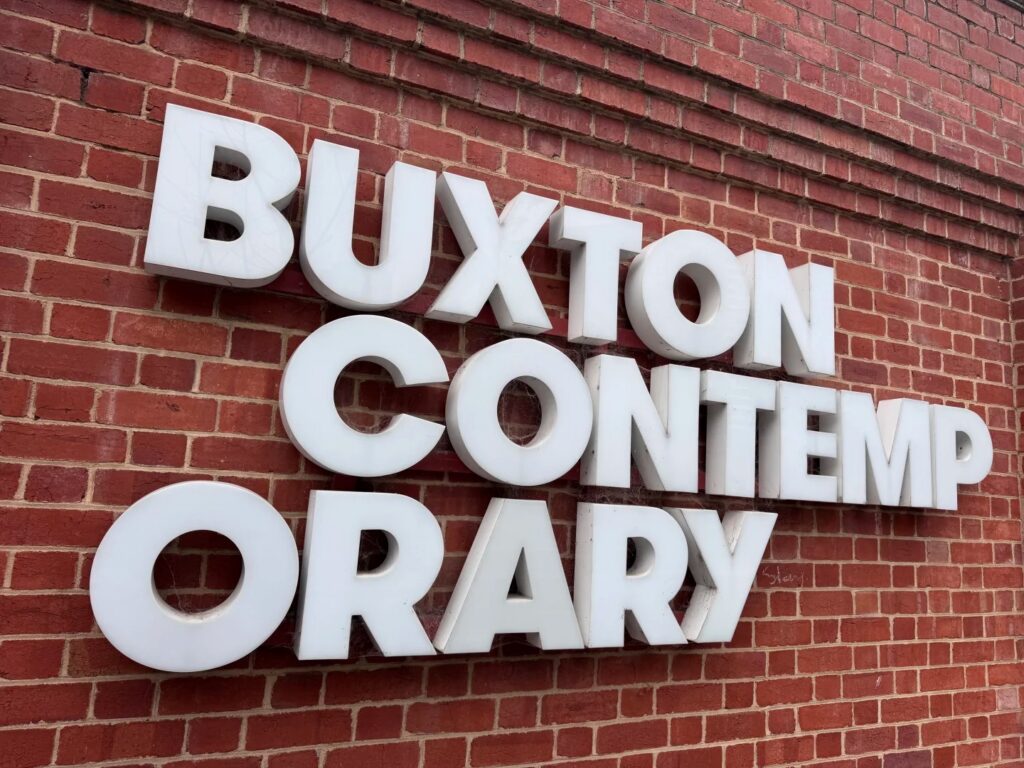
You know it’s a slow Melbourne day when you can walk to the supermarket in your pyjama pants and not run into a single person you know. That was the plan for this particular afternoon — nothing more ambitious than milk and bread — until a friend messaged about a small exhibition she’d seen on Xiaohongshu, something about oranges. We were already near NGV, so we figured why not, and ended up at Buxton Contemporary instead, right as it was showing its new exhibition, Poetry goes no further than language.
If you haven’t been, Buxton Contemporary sits right on the corner of Southbank Boulevard and Dodds Street, on the University of Melbourne’s Southbank campus — close enough to NGV International that you could genuinely do both in one afternoon without much walking at all, especially if you’re already working through our guide to school holiday activities in Melbourne. It’s one of those Melbourne galleries people tend to forget exists, mostly because it doesn’t shout about itself the way NGV does. Entry is free, no booking required, open Tuesday to Saturday, 11am to 5pm (closed Sunday and Monday, which caught us out on a previous visit).
What Poetry Goes No Further Than Language actually is
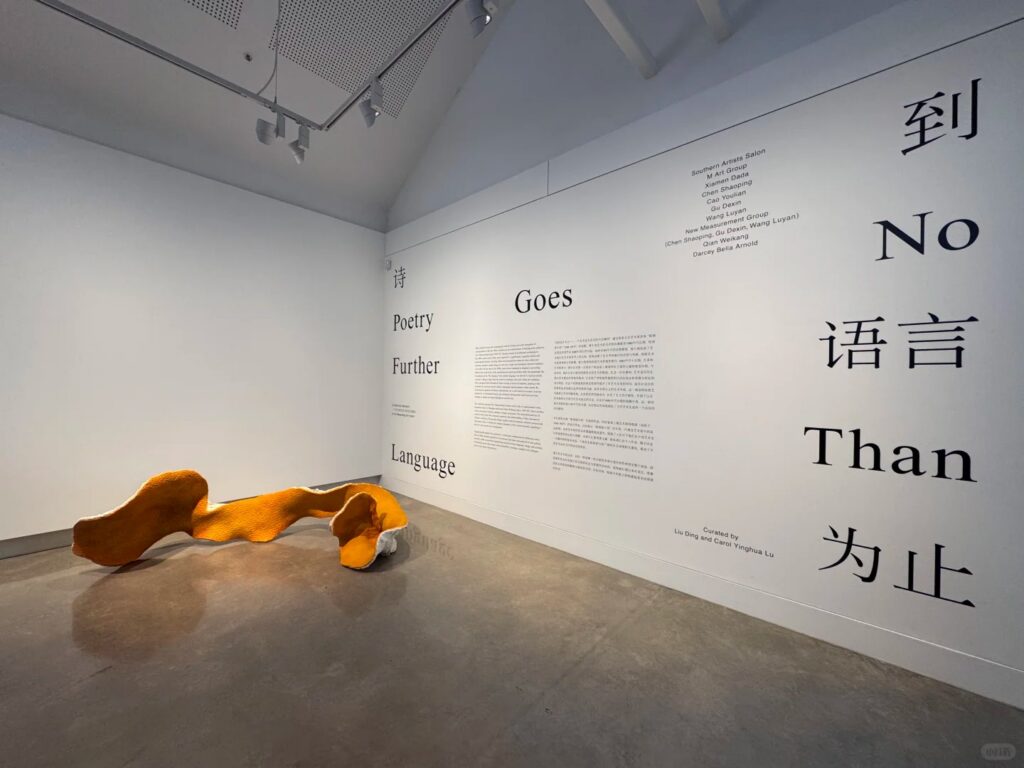
The exhibition currently on is called Poetry goes no further than language: A historical moment of art becoming art again, running from 1 May to 3 October 2026. It’s curated by Liu Ding and Carol Yinghua Lu — Lu is the director of Beijing’s Inside-Out Art Museum and did her PhD at the University of Melbourne, which is partly why the show ended up here rather than somewhere in Asia.
The premise, once you dig past the abstract title, is more grounded than it sounds. It revisits a specific moment in Chinese art history — the mid-to-late 1980s through the early 1990s — when a small group of artists in Beijing and Shanghai started questioning what art was even allowed to be. Two names carry most of the show: the Beijing collective New Measurement Group, active from 1989 to 1995, and Shanghai-based artist Qian Weikang, active from around 1990 to 1995. Their work leans heavily on measuring, recording and writing — turning everyday, almost bureaucratic actions into something closer to an experiment than a painting. It’s genuinely one of those exhibitions where the wall text does a lot of the heavy lifting, and thankfully all of it is bilingual — English and Chinese — which the gallery says is actually a first for Buxton Contemporary.
I won’t pretend I walked out with a fully formed opinion. Honestly, a lot of it is quite abstract, and if you’re after something immediately emotional or easy to photograph for its own sake, this might not be it. But it’s a genuinely interesting way to spend thirty minutes to an hour, and it’s rare to see this particular slice of Chinese conceptual art history shown anywhere in Australia, let alone for free.
The oranges, though
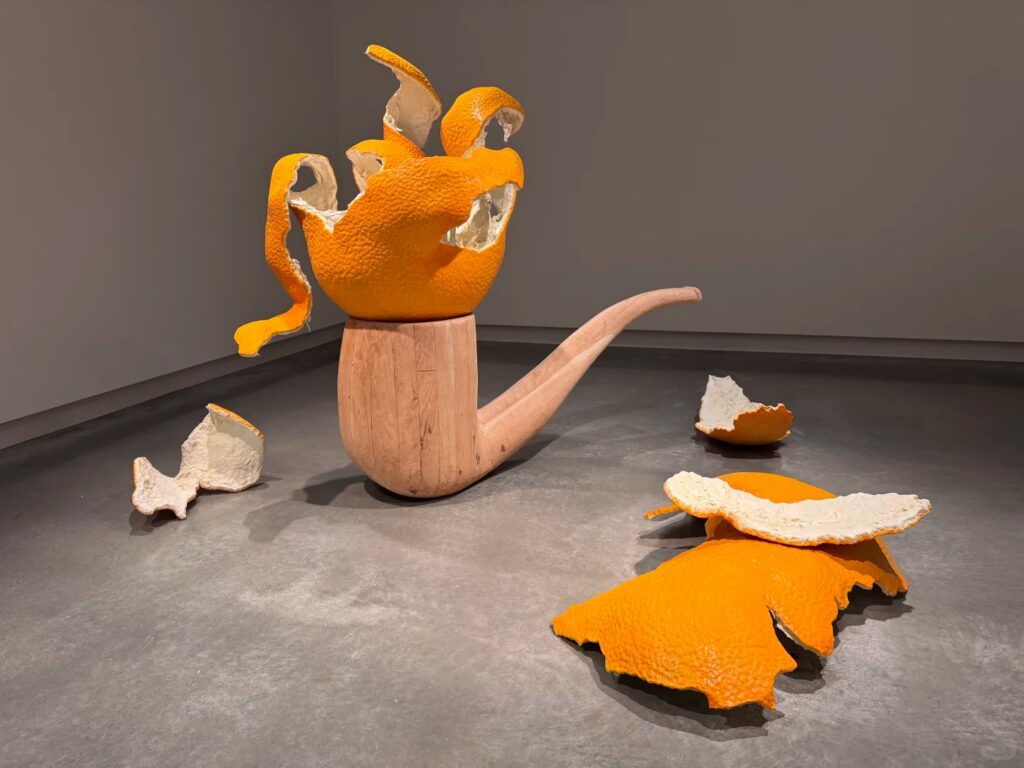
The reason we actually went — and probably the reason most people are hearing about this show at all — is a new commission woven through the whole space by Melbourne-based artist Darcey Bella Arnold, a Victorian College of the Arts graduate whose practice is built around language. Her orange peel sculptures are scattered through the gallery in a way that feels almost accidental, tucked into corners, and — this was the moment that got us — sitting up along the roof beams where you genuinely wouldn’t expect to look. Up close, the detail is unsettlingly realistic. The main piece is titled Orange Mandarin (2026), alongside others including A Pipe is not a Poem and Fruit of Chance 11.
Then there’s the elevator. This is a small thing, but it’s the bit everyone seems to mention — the doors open and there’s a single orange peel sitting on the floor, as if someone just left it there. We took an embarrassing number of photos in that lift. If I could ask the gallery for one thing, it would be a mirror on the elevator ceiling — the whole moment is begging for it, and right now you can’t quite capture the full effect from one angle.
Don’t skip the walk afterwards
We’d gone into the gallery not expecting much beyond killing an hour, and came out into a proper Melbourne evening — the kind where the light turns that particular shade of blue over the Yarra. We ended up on one of the bridges near Flinders Street, looking back at the skyline lit up, and it’s a strange thing to say about a bridge I’ve crossed dozens of times, but standing there that night actually caught me off guard. If you time your visit for late afternoon, closer to the 5pm close, you get the gallery and that walk back through Southbank as a kind of package deal, which is honestly the better version of this outing.
If you’re already planning a day around NGV, Buxton Contemporary is an easy, free add-on that most visitors skip entirely — check out our broader guide to what to do on holiday in Melbourne for more ideas nearby — and this particular show, orange peels aside, is a rare chance to see part of Chinese contemporary art history that essentially never travels to Australia. Just don’t go on a Sunday or Monday, and budget the extra twenty minutes for the elevator photos. You’ll need them.
Poetry goes no further than language: A historical moment of art becoming art again Buxton Contemporary, corner of Southbank Boulevard & Dodds Street, Southbank VIC 3006 1 May – 3 October 2026 · Tuesday–Saturday, 11am–5pm · Free entry, no booking required