

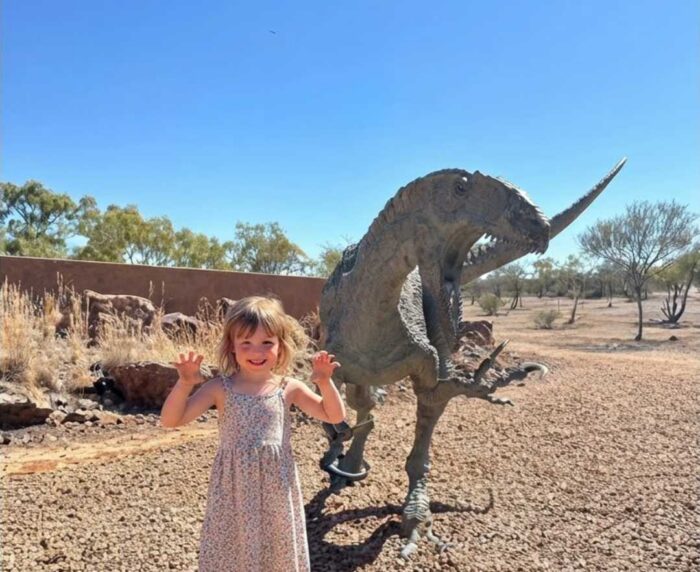
We weren’t planning to spend three days chasing dinosaurs. We were just passing through outback Queensland, and someone at a caravan park mentioned “the Dinosaur Trail” the way locals mention things they assume you already know about. A quick search later, we’d rearranged the whole trip around it.
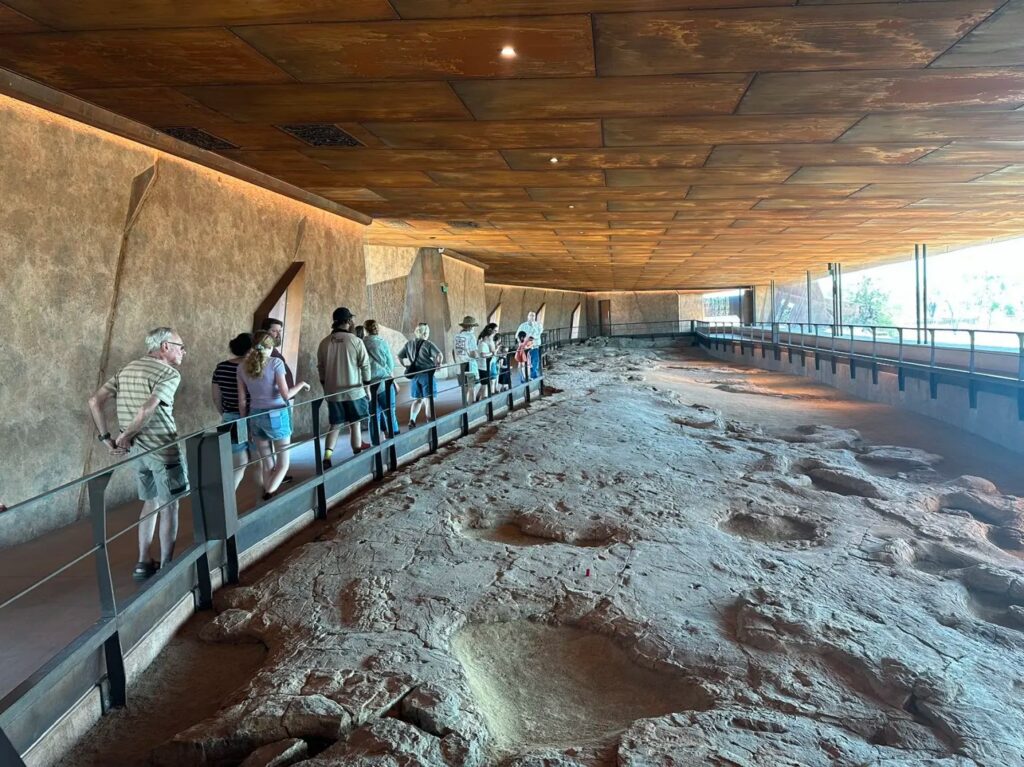
Australia’s Dinosaur Trail links three towns — Winton, Richmond and Hughenden — strung along the Flinders Highway in western Queensland, each built around a different fossil discovery. Between them sit four attractions: the Australian Age of Dinosaurs and the Lark Quarry Dinosaur Trackways near Winton, Kronosaurus Korner in Richmond, and the Flinders Discovery Centre in Hughenden. We managed the first three. Lark Quarry is another hour and a half down a dirt road, and we’d already pushed our schedule as far as it would go.
Winton – a sheep station that became a fossil capital
The Australian Age of Dinosaurs museum sits on a mesa called The Jump-Up, twenty-odd kilometres out of Winton, and the story behind it is better than anything in the exhibits. In 1999, a grazier named David Elliott was out mustering sheep on his own property when he found a fossilised bone. It turned out to belong to one of the largest dinosaurs ever found in Australia. He and his wife Judy spent the next few years fundraising, and in 2002 they registered the museum as a not-for-profit — not a government project, which is what I’d assumed walking in. The Jump-Up site itself was donated by another local family in 2006, and the museum moved there in 2009.
I asked one of the guides how the place actually runs, and the answer was simpler than I expected: ticket sales, gift shop and cafe income, donations, and a small team that’s grown from almost nothing to somewhere around twenty to thirty staff and volunteers. It’s still David Elliott’s project — he’s the executive chairman — and the museum has since gone on to house what’s described as the world’s largest collection of Australian dinosaur fossils, along with the country’s most productive fossil preparation lab.
You can’t just wander in and look around, which caught a few people in our group off guard. Visits run as timed, guided tours between the Fossil Preparation Laboratory, the Collection Room, and Dinosaur Canyon, so it’s worth booking ahead rather than turning up on spec. The Ultimate Dinosaur Tour is the one to get if you only do one thing — it covers all three and runs a few hours all up.
The outback earns its name
What struck me more than any single fossil was the environment these museums operate in. Winton, Richmond and Hughenden are small — a few thousand people between them — with servos and a pub or two rather than supermarkets. Summers are properly hot and the country turns dry and red for as far as you can see. It’s the kind of landscape where a chance find on a working sheep station can sit undisturbed for tens of millions of years, which is part of why outback Queensland has turned out to be so rich in fossils in the first place. Running a museum out here, on volunteer hours and ticket income, in a town this size, is a genuinely bigger undertaking than it sounds from the brochure.
Richmond – what used to be an inland sea
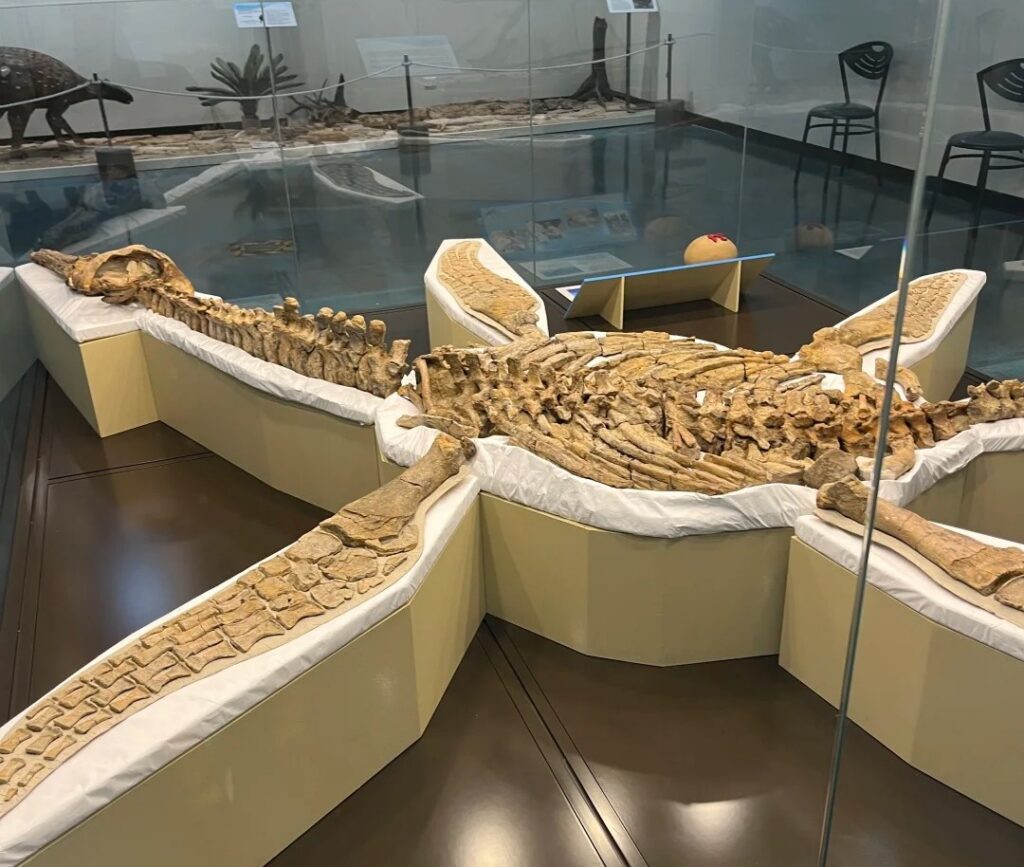
Richmond is about two hours north-east of Winton, and the shift in subject matter is immediate. A hundred million years ago this part of Queensland was underwater — the Eromanga Sea — and Kronosaurus Korner is built around what came out of it: marine reptiles, not land dinosaurs. The museum’s centrepiece is its collection of pliosaur and Kronosaurus fossils, including the “Richmond Pliosaur,” found on a nearby station in 1989 and rated as one of the best-preserved marine reptile fossils in the world.
Kronosaurus Korner started life differently to Winton’s museum. Local landholders and volunteers pushed for it after that 1989 find, it opened in 1995 in a converted old cinema, and it’s since been run under Richmond Shire Council rather than as an independent charity. That’s worth knowing if, like me, you assume every small regional museum is run the same way — some are community-and-council operations, some are private not-for-profits, and it changes how they’re funded and staffed.
We’d booked onto a “Digging at Dawn” tour, which takes you out to a real fossil site and hands you a rock hammer. It’s slower than it sounds — you’re tapping layer after layer of stone apart rather than digging with a shovel — but that’s most of the appeal. Somewhere around the third layer my son found part of a shell, and the two hours went a lot faster after that.
Hughenden – the trail’s quieter final stop
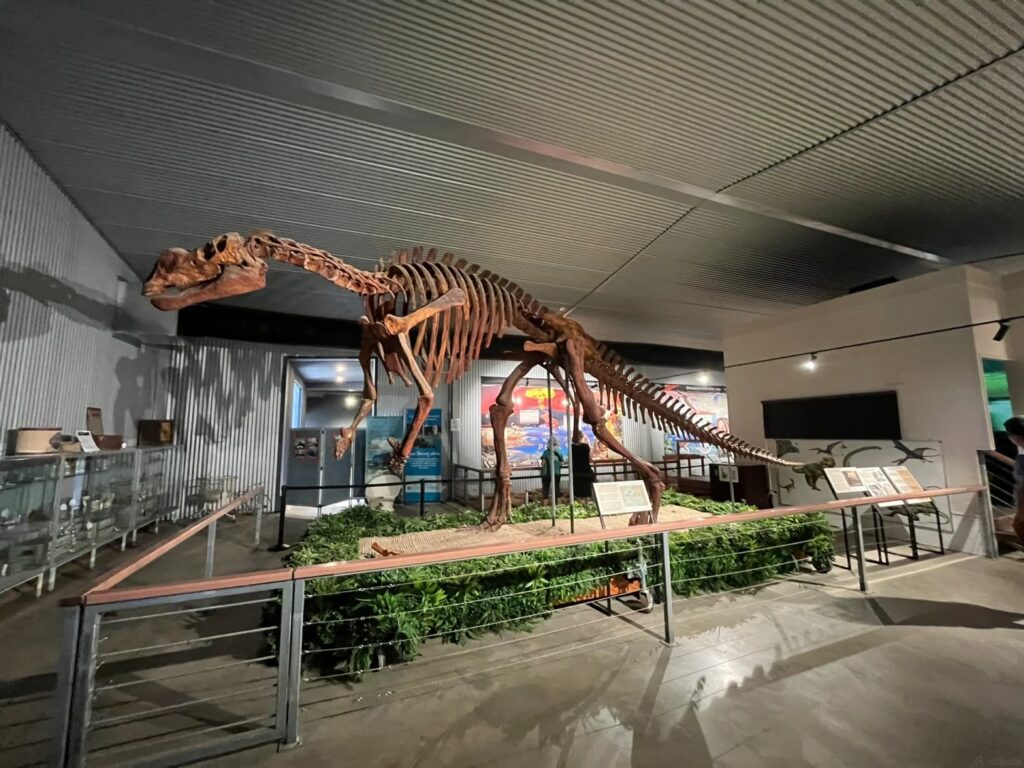
Hughenden is the smallest of the three towns and the Flinders Discovery Centre, run through the local council’s visitor information centre, is easy to underestimate. “Hughie,” a life-size Muttaburrasaurus replica, is the drawcard, but the centre spends just as much space on the region’s geology — there’s a short film on how nearby Porcupine Gorge formed, laid out layer by layer — and on the area’s sheep and cattle history. A section called “Shearing the Stragglers” traces the decline of the wool industry from 1865 onward, which sounds dry until you realise it’s told through the people who actually lived it. There’s a kids’ corner with books and drawing, and honestly, by this point in the trip my son needed one.
The bit that surprised me most wasn’t a fossil
Somewhere between the three museums I started assuming today’s sharks, crocodiles and dolphins were basically the same animals as their prehistoric look-alikes, just smaller and calmer. A guide at Kronosaurus Korner corrected that gently: Kronosaurus and the other big marine reptiles on display there aren’t ancestors of modern crocodiles or dolphins at all. They’re a completely different, now-extinct branch of reptile, and the resemblance to today’s sharks and dolphins is convergent evolution — similar shapes evolving separately to suit the same hunting lifestyle, not one group softening into the other over time. It’s a small correction, but it changed how I looked at every skeleton for the rest of the day.
Riverdale Park, Meadowbrook — the free Brisbane option
We’ve been back to Riverdale Park four times now, and our son still doesn’t want to leave when it’s time to go. If your kids are into dinosaurs and climbing, this is about as good as a free council playground gets. It’s in Meadowbrook, in Logan, about half an hour south of the Brisbane CBD.
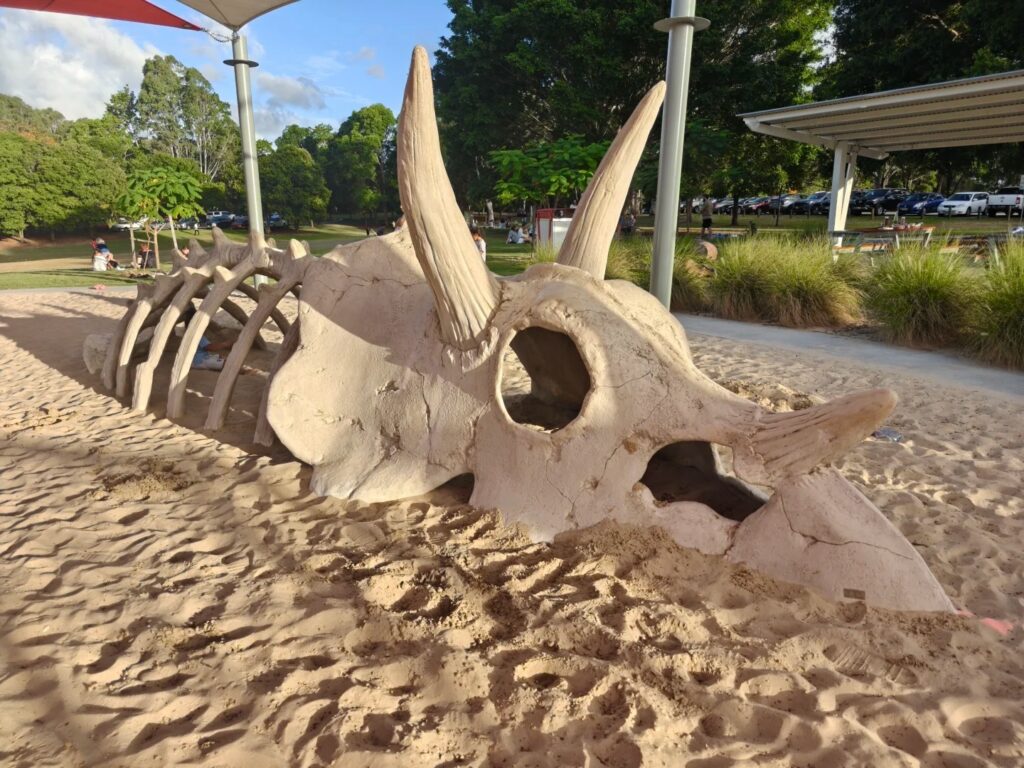
The dinosaur theming is everywhere, not just on one climbing frame. There are dinosaur footprints set into the paths, dinosaur eggs and baby dinosaur sculptures tucked around the garden beds, a sunken triceratops skeleton kids can climb through, and a fossil dig pit where something new always seems to be half-buried. Even small details like the bin surrounds pick up the theme, which is the kind of thing that only really registers once your kid has pointed it out to you for the third time.
If you’re planning to do this trip
Distances are the main thing to plan around — it’s roughly six to seven hours of driving between the three towns if you don’t stop, and most people spread it over three to four days rather than doing it as a loop from the coast. School holidays are the obvious window if you’re travelling with kids, and it’s worth checking QLD school holiday dates before you lock anything in, since the shoulder seasons either side of the school holidays are noticeably cooler and quieter than midsummer. Book the Winton and Richmond tours ahead of time rather than assuming you can walk up, and budget more time than you think — we planned two nights and needed three.
None of the three towns will hold a child’s attention with lights and rides the way a theme park does. What they do instead is let kids handle something real — a fossil bed, a fragment of shell, a rock hammer — in a landscape that makes the scale of it obvious. If your family already leans toward museums over amusement parks, outback Queensland delivers on a scale the coast can’t really match.