

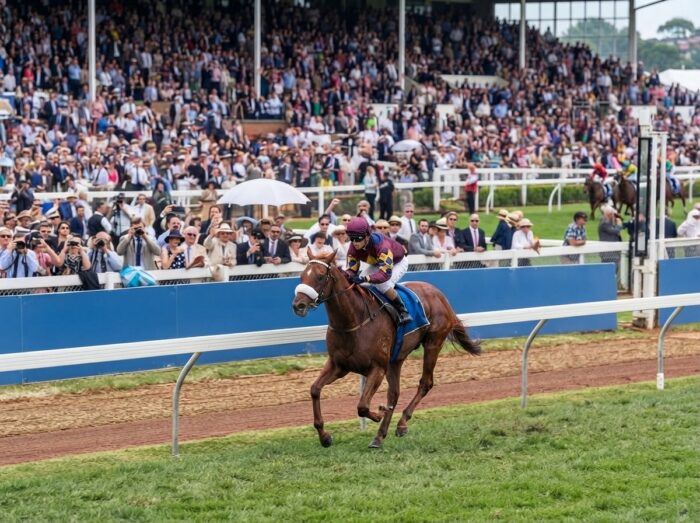
The Melbourne Cup — “the race that stops a nation” — falls right in the middle of Term 4 school holidays planning season, and it’s the perfect excuse for a family trivia night, a classroom quiz, or just settling an argument at your Cup Day lunch. We’ve fact-checked every question and answer below against official race records, so you can trust what you’re serving up.
Whether you’re planning a Victorian public holidays long weekend around Cup Day, looking for family trivia night ideas, or just want to sound smart at the sweepstake table, here are 84 questions covering the Cup’s history, its legendary horses, its records, and its traditions.
Jump to a section:
- History & Origins (18 questions)
- Records & Legends (20 questions)
- Traditions & The Modern Cup (24 questions)
- Recent Winners & Quick-Fire Facts (22 questions)
History & Origins
1. In what year was the first Melbourne Cup run? 1861.
2. Where is the Melbourne Cup held? Flemington Racecourse in Melbourne, Victoria — it has never had another home.
3. Which horse won the very first Melbourne Cup? Archer, ridden by jockey John Cutts and trained by Etienne de Mestre.
4. How many horses started in the first Melbourne Cup? 17 starters lined up, after a much larger number of horses were originally nominated and several were scratched before race day.
5. What day of the week was the first Melbourne Cup run on? A Thursday — 7 November 1861. The race didn’t move permanently to Tuesdays until 1875.
6. What organisation ran the first Melbourne Cup? The Victoria Turf Club, which created the race to rival the Victoria Jockey Club’s events.
7. What body organises the Melbourne Cup today? The Victoria Racing Club (VRC), formed in 1864 when the Turf Club and Jockey Club merged.
8. What was the prize for winning the first Melbourne Cup? A gold watch plus a cash purse, commonly cited at around £710.
9. Did Archer win the Melbourne Cup again? Yes — he won again in 1862, beating the same horse, Mormon, by 8 lengths, a record winning margin that stood until it was equalled by Rain Lover in 1968.
10. When was the first proper trophy cup awarded? 1865, won by the horse Tory Boy. Before that, winners received a watch or cash rather than a trophy.
11. Since which year has the Cup always run on the first Tuesday of November? 1875.
12. What is the current length of the Melbourne Cup? 3,200 metres — roughly two miles.
13. Was the race always run over 3,200 metres? It was run over two imperial miles until Australia’s switch to the metric system converted the distance to 3,200m in 1972.
14. Has the Melbourne Cup ever been cancelled? No. It has run every single year since 1861, including through both World Wars (it was even shifted to a Saturday in 1942–1944 during WWII rather than being called off).
15. Where does the name “Flemington” come from? Contrary to popular belief, it wasn’t named after early settler Robert Fleming — the name is linked to a place called Flemington in Morayshire, Scotland, connected to an early landowner’s family.
16. Is the Melbourne Cup a handicap race or a weight-for-age race? It’s a handicap — each horse carries a different weight, assigned by the official handicapper based on ability, to try to level the field. This is different from “weight-for-age” races like the Cox Plate, where weight is set purely by age and sex.
17. What nickname is the Melbourne Cup best known by? “The race that stops a nation.”
18. Is Melbourne Cup Day a public holiday? Yes — it’s been a public holiday across Victoria since 1877, and while it’s not an official holiday in other states, workplaces around the country traditionally pause for the 3pm race.
Records & Legends
19. Which horse holds the record for the most Melbourne Cup wins? Makybe Diva, who won three in a row — 2003, 2004 and 2005. She’s the only horse ever to win three consecutive Cups, and the only mare to win more than once.
20. Who rode Makybe Diva to all three of her Cup wins? Jockey Glen Boss.
21. Which trainer has won the most Melbourne Cups? Bart Cummings, with 12 wins between 1965 and 2008 — earning him the nickname “the Cups King.”
22. What was Bart Cummings’ first Melbourne Cup winner? Light Fingers, in 1965.
23. What was Bart Cummings’ last Melbourne Cup winner? Viewed, in 2008 — exactly 50 years after he first entered a runner in the race.
24. Which two jockeys share the record for most Cup wins by a jockey? Bobby Lewis (1902, 1915, 1919, 1927) and Harry White (1974, 1975, 1978, 1979) — four wins each.
25. Who was the first woman to win the Melbourne Cup as a jockey? Michelle Payne, in 2015, aboard Prince of Penzance.
26. What were Prince of Penzance’s starting odds in 2015? 100/1 — making Payne’s win one of the biggest upsets in Cup history.
27. Who became the second female jockey to win the Melbourne Cup? Jamie Melham, in 2025, aboard Half Yours — a decade after Michelle Payne’s historic first.
28. What extra record did Jamie Melham set with her 2025 win? She became the first jockey to complete the “Cups Double” — winning the Caulfield Cup and Melbourne Cup in the same spring carnival.
29. Which horse famously won the 1930 Melbourne Cup during the Great Depression? Phar Lap, who became a symbol of hope for the country during hard economic times.
30. What weight did Phar Lap carry to victory in 1930? Around 62.5kg — top weight in the race — while starting a very short-priced favourite.
31. How did Phar Lap perform in the 1929 Melbourne Cup, the year before? He ran third, beaten into the placings by Nightmarch.
32. What double did Nightmarch achieve in 1929? He became the first horse to win both the Melbourne Cup and the Cox Plate in the same year.
33. Which horse carried a record 66kg to victory in the largest-ever Melbourne Cup field? Carbine, in 1890 — in a field of 39 runners, still the biggest field in Cup history.
34. What is the smallest field to ever contest the Melbourne Cup? Just seven runners, in 1963.
35. How many horses can run in a modern Melbourne Cup? A maximum of 24 starters, a limit introduced for safety reasons.
36. Has there ever been a dead heat for first place in the Melbourne Cup? No — there has never been a dead heat for the win, though there have been two dead heats for third place, in 1933 and 1999.
37. What is the fastest time recorded for the modern 3,200m Melbourne Cup? 3:16.30, set by Kingston Rule in 1990.
38. Who was the first Northern Hemisphere-trained horse to win the Melbourne Cup? Vintage Crop, an Irish stayer trained by Dermot Weld, in 1993 — opening the door to the modern era of international “raiders.”
Traditions & The Modern Cup
39. What time does the Melbourne Cup traditionally start? 3:00pm AEDT.
40. On what date does the Melbourne Cup always fall? The first Tuesday in November.
41. What other race days make up the Melbourne Cup Carnival at Flemington? Derby Day, Melbourne Cup Day, Oaks Day (also called Ladies’ Day) and Stakes Day, spread across two race weekends.
42. How is the Melbourne Cup trophy made? It’s a solid 18-carat gold trophy, hand-crafted from dozens of pieces of gold hand-beaten over roughly 200 hours.
43. When did the familiar three-handled “loving cup” trophy design become standard? 1919. Before that, a new design was often created each year, and in the race’s early decades no trophy was awarded at all in some years.
44. Do the winning trainer and jockey get their own trophy? Yes — since 1973 they’ve each received a miniature replica of the Cup.
45. What is the Tommy Woodcock Trophy? An award presented to the winning strapper, named in honour of Tommy Woodcock, the devoted strapper of Phar Lap.
46. What happens to the Melbourne Cup trophy after the race? A brand-new cup is struck each year and becomes the permanent property of the winning owner.
47. Roughly how much prize money is on offer at the modern Melbourne Cup? The total prize pool has grown to around $8–10 million in recent years, with the winning connections taking home several million dollars of that.
48. Which Australian TV network currently broadcasts the Melbourne Cup free-to-air? The Nine Network, after the rights moved between the Seven and Ten networks in earlier years.
49. About how many people attend the Melbourne Cup at Flemington? Typically 70,000–90,000-plus in recent years, with historic crowds once topping 100,000 — the attendance record stands at over 122,000 in 2003.
50. What competition rewards the best-dressed racegoers on Cup Day? Fashions on the Field, a major style competition that has run since 1962.
51. What are the elaborate headpieces often worn on Cup Day called? Fascinators, worn alongside more traditional formal hats.
52. What’s an office “Cup sweep”? An informal draw where colleagues each chip in a small amount and are randomly assigned a horse, sharing in the winnings if their horse places — a huge Cup Day tradition even among people who don’t normally bet.
53. Is Melbourne Cup Day a public holiday across all of Australia? No — it’s an official public holiday only in Victoria. Elsewhere, most workplaces simply pause around 3pm to watch the race.
54. What sponsor’s name has recently been attached to the race? Lexus — the race has been run as the “Lexus Melbourne Cup” in recent years, after Emirates held the naming rights for many years before that.
55. What is the minimum age for a horse to run in the Melbourne Cup? Three years old.
56. Roughly how many horses are nominated each year compared to how many actually start? Around 300–400 horses are nominated, but only 24 make the final field.
57. How is it decided which horses miss out on a Melbourne Cup start? Through a ballot system that weighs factors like prize money earned, form in lead-up races, and the horse’s handicap rating.
58. Do international horses need to quarantine before running in the Cup? Yes — they must complete a minimum 14-day quarantine period before travelling to Australia, often based at Werribee, Victoria.
59. Which starting barrier has historically produced the most Melbourne Cup winners? Barrier 5, which has produced winners regularly since 1925.
60. What does “the race that stops a nation” actually mean in practice? At 3pm on Cup Day, offices, schools (where in session) and public spaces across Australia traditionally pause to watch the race live, even in states where it isn’t a public holiday.
61. How long is the Melbourne Cup Carnival overall? The four official race days span roughly eight days across two weekends in late October/early November.
62. What’s the traditional Cup Day drink most associated with the celebrations? Champagne, usually alongside a Cup Day lunch — though of course, plenty of families celebrate with a simple backyard barbecue and a sweep instead.
Recent Winners & Quick-Fire Facts
63. Who won the 2025 Melbourne Cup? Half Yours, ridden by Jamie Melham and trained by Tony & Calvin McEvoy.
64. Who won the 2023 Melbourne Cup? Without A Fight, ridden by Mark Zahra and trained by Anthony & Sam Freedman.
65. Who won the 2022 Melbourne Cup? Gold Trip, ridden by Mark Zahra and trained by Ciaron Maher & David Eustace.
66. Which jockey has won the Melbourne Cup three times on three different horses? Damien Oliver, aboard Doriemus (1995), Media Puzzle (2002) and Fiorente (2013). Kerrin McEvoy has also won three times, on Brew (2000), Almandin (2016) and Twilight Payment (2020).
67. Roughly what percentage of Melbourne Cups have been won by the race favourite? Around 32% — better than pure chance, but still low enough that the Cup is famous for producing long-priced upsets.
68. Which legendary Cup mare passed away in early 2026? Makybe Diva, who died in February 2026 at the age of 27, remembered as the greatest Cup horse in the race’s history.
69. How many foals did Makybe Diva produce as a broodmare? Ten, during her breeding career after retiring immediately following her third Cup win in 2005.
70. What was Makybe Diva’s total career prize money? More than $14.5 million from 36 career starts, including 15 wins.
71. Which other major race did Makybe Diva win in 2005, alongside her third Cup? The Cox Plate.
72. How old was Michelle Payne when she won the 2015 Cup? 30.
73. What serious injury had Michelle Payne recovered from earlier in her career? A fractured skull, suffered in a race fall in 2004.
74. What made Michelle Payne only the fourth female jockey in the race’s 155-year history at that point? Female jockeys had rarely been given rides in the Cup at all — she was just the fourth woman ever to get a mount in the race before she went on to win it.
75. What does “handicap” actually mean in horse racing? Each horse carries a different weight, set by an official handicapper based on its ability, so that in theory every runner has an equal chance of winning.
76. What race is often used as the key lead-up test for Melbourne Cup chances? The Caulfield Cup, held a few weeks earlier in the same spring carnival.
77. What’s the informal name for winning the Caulfield Cup and Melbourne Cup in the same year? “The Cups Double” — a rare and highly prized achievement.
78. How does the Melbourne Cup’s distance compare to a standard mile? At 3,200m, it’s roughly double the length of a mile (about two miles) — a genuine test of a horse’s staying power.
79. What direction does the track run at Flemington? Left-handed (anti-clockwise), like most major Australian tracks.
80. What did Bart Cummings achieve five times that no other trainer has matched as often? A Melbourne Cup “quinella” — training both the first and second placegetters in the same race.
81. From which decade did international “raider” horses start regularly contesting the Cup? The 1990s, following Vintage Crop’s breakthrough win for Ireland in 1993.
82. What happens to a horse’s entry fee if it’s balloted out of the final field? It’s refunded — horses only forfeit their final declaration fee if they make the field and then don’t run.
83. Which horse’s story is honoured every year through the strapper’s award? Phar Lap’s — via the Tommy Woodcock Trophy, named after his lifelong strapper and friend.
84. In one sentence, why is the Melbourne Cup such a big deal in Australia? It’s a 160-plus-year-old sporting tradition that combines a genuine international Group 1 horse race with a nationwide social occasion — office sweeps, fashion, family lunches and a whole country pausing at 3pm on a Tuesday to watch.
Bring the Trivia to Your Own Cup Day
However you’re spending the first Tuesday in November — a school trivia afternoon, a family lunch, or just settling a bet with the kids — these questions are a ready-made quiz. For more quiz nights, browse our full trivia collection, find things to do with kids near you, or check 2026 school holiday dates for every state to plan around the Cup Day long weekend.