

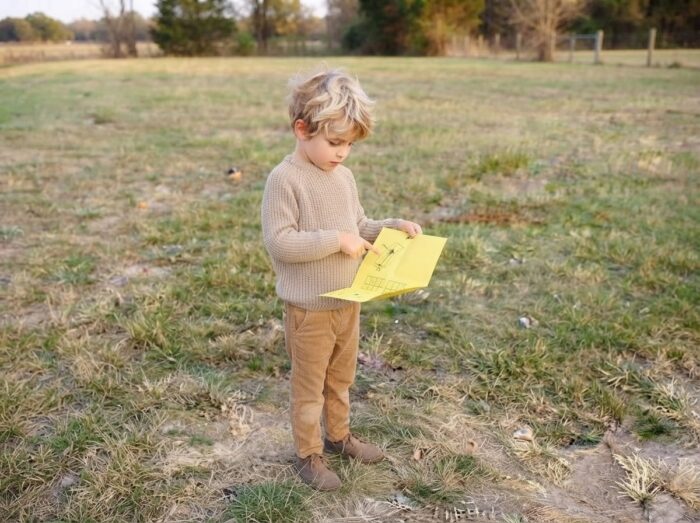
Day four of the school holidays. The kids were upside down on the couch, doing that thing where they announce they’re “SO bored” like it’s my fault personally. I didn’t have a plan. Didn’t have a Pinterest board, didn’t have anything, really, except a biro and the sudden realisation that the backyard had been sitting there the whole time, completely wasted.
A scavenger hunt is one of the easiest wins going, and I don’t say that lightly — we’ve tried most of the alternatives at this point, the paid ones and the elaborate ones and the ones that need forty minutes of prep the night before. This one needs none of that. No bookings, no driving, no money leaving your account. Just the yard you’ve already got, some paper, and about twenty minutes while the kids are too busy arguing over whose turn it is to feed the dog to notice you’re setting something up.
So here’s what we’ve got: 50 clues, split into four categories, so you’re not scrolling through one enormous list trying to work out which bits actually suit your yard. There’s two ways to run it depending on your energy levels that day, notes on scaling it up or down by age, a couple of safety things that actually matter here (not the generic “watch for cars” stuff every list has), and some quick swaps if you want to use it for a birthday or Christmas instead.
Jump to:
- Why This Actually Works
- Two Ways to Run It
- Adjusting for Age
- Safety Notes
- The 50 Clues
- Quick Theme Twists
Why This Actually Works
Why does it work so well. Mostly because there’s no setup involved, you’re literally just using whatever’s already scattered around the yard, so no emergency trip to Bunnings, no realising halfway through that you don’t actually own pinecones. And it scales itself, that’s the bit that gets me. My youngest is over the moon just finding “something soft” while her brother’s out there wanting an actual proper challenge, and neither of them seems to notice it’s just “go outside and play” with a fancy new outfit on. Say that phrase on its own though and you get the eye roll. Every time, without fail.
If you’re the sort who likes to track the learning stuff, there’s a bit of that hiding in here too — comparing, sorting, following instructions properly for once instead of half listening. We don’t really bother keeping tabs on it ourselves, but it’s nice when it sneaks in anyway.
Once the cards are made that’s basically the whole job done. Laminate them if you want them to survive more than one holidays (I never do, mine end up soggy in the garden by lunchtime, no regrets), and next time you need twenty minutes of peace they’re already sitting there ready to go.
Two Ways to Run It
First option, the relay hunt. Hide clue one somewhere obvious, that leads to clue two, clue two leads to clue three, all the way through to a small prize at the end. Doesn’t need to be much. Bowl of snacks, a water pistol, half the time “you found it, well done” is enough and the kids couldn’t care less what the actual prize was. Keep it to 8-12 clues or it starts to drag and someone loses interest halfway. This is the one we do when there’s twenty minutes before dinner and that’s genuinely all the time we’ve got.
Second option, checklist style. This is where you actually use the full fifty. Print it, one copy per kid or a basket each, timer on, off they go. Nothing needs hiding in advance which makes it a much easier one for a birthday party — you’re not relying on one kid finding a clue before anyone else can move on.
Adjusting for Age
For the little ones, toddlers and preschool age, skip the written clues and use photos instead. Take a few quick pics around the yard, the letterbox, a garden gnome if you’ve got one, the hose, whatever’s around, and get them matching photo to object. Five items is plenty. Maybe eight if they’re really into it, but don’t push past that.
Kids in early primary can usually manage the written clues but I’d still read them out loud rather than making it a reading exercise under time pressure — that’s not really the point of the holidays. Ten to fifteen clues before someone spots a bug and that’s the hunt over for them.
Upper primary and up, just give them the list. Add a timer if they’re the competitive type (mine absolutely is). If you want to push it further, take a few of the Hidden Treasures clues near the end and turn them into actual riddles instead of plain instructions. That age group tends to love the extra puzzle, weirdly.
A Couple of Safety Notes Worth Knowing
Most of this is common sense, but two or three things are genuinely worth a mention before kids start rummaging around, especially through spring and summer.
Get an adult to check under rocks, pots, logs or anywhere near a wood pile before little hands go in — redbacks like exactly these spots, and they’re common in backyards right across the country, not just somewhere rural. Takes two seconds to flip the rock yourself first. Or just make that particular clue a “look, don’t touch” one.
If the hunt’s happening in the middle of the day, the usual sun stuff applies — hat, sunscreen, a reminder to actually drink some water, because kids chasing clues around a yard forget they have a body that needs things. Magpie swooping season runs roughly August to November in most states, so if a clue’s hidden near a tree a magpie’s claimed as its own, just move it, don’t risk it. Anywhere near bush on the east coast, a tick check afterwards isn’t a bad habit either. And if a clue happens to lead them to a blue-tongue or a gecko sunning itself — look, don’t pick up. Better for the lizard, one less thing for you to worry about.
None of this needs a big sit-down talk. Thirty seconds before you start and you’re back to a normal afternoon.
The 50 Clues
Print these, cut them into cards, or just read them off your phone as you go. Grouped into four categories so you can pick and choose based on what’s actually in your yard.
🌿 Nature & Garden
- Find a leaf that’s bigger than your hand.
- Spot a flower with yellow petals (wattle counts, if it’s flowering).
- Find something rough and something smooth.
- Ask an adult to help you check under a rock or pot for a tiny bug.
- Find a twig that looks like the letter Y.
- Collect three different types of leaves.
- Find a feather or spot a bird’s nest (don’t touch the nest).
- Look for a plant with thorns or prickles.
- Find a stone that’s a funny shape.
- Spot a butterfly, bee or ladybird.
- Find something green that grows low to the ground.
- Look for a tree with big, low branches.
🏡 Yard & House Features
- Go to the spot where the car gets washed.
- Find where the grass gets mowed.
- Look near where you cook outside (the barbecue).
- Go to the chair or bench where someone sits to relax.
- Find the door that leads back inside the house.
- Look under the doormat.
- Go to the spot where the birds come for a drink.
- Find the tool used for digging in the garden.
- Look near the fence line around the yard.
- Go to the swing, trampoline or slide.
- Find the garden hose.
- Look at where the bins live.
🎒 Collect & Create
- Take a photo of something red.
- Find something that makes a sound when you blow on it.
- Collect 5 gumnuts, pinecones or seed pods.
- Find something that sparkles or shines in the sun.
- Take a photo with a garden ornament or gnome, if you have one.
- Find a leaf that’s turned brown or dry.
- Collect 3 smooth stones.
- Find something soft to touch.
- Take a selfie in front of the biggest tree in the yard.
- Find a flower that smells nice.
- Collect a feather and a twig together.
- Find something the wind can move.
🕵️ Hidden Treasures
(for hiding the final prize or clue cards) 37. Look where the sun hits the grass first in the morning.
- Check near the corner of the shed or garage.
- Look behind the biggest pot plant.
- Check under an outdoor chair.
- Find the spot where the family pet likes to nap.
- Look inside an empty watering can.
- Check the letterbox for a surprise.
- Look under the stepping stones or pavers.
- Find where the bikes or scooters are kept.
- Look behind the coiled-up garden hose.
- Check the swing set or trampoline frame for something hidden.
- Look near a tree root (no digging needed, just a peek).
- Check inside an outdoor storage box, if you have one.
- Look under a folded picnic blanket or towel.
Quick Theme Twists
Once you’ve run the standard version, the same list stretches to cover pretty much any occasion — really you’re just swapping the prize at the end and a handful of clues.
Birthday? Run it as a relay with the last clue leading to the lolly bags or the cake table. Easter — swap a few of the Collect & Create clues for chocolate egg finds, the Hidden Treasures section basically doubles as an egg hunt already, no real changes needed. Christmas, hide a small gift or a candy cane at the end instead of snacks, throw in a “find something red and green” clue while you’re at it. Australia Day or a summer barbecue, keep it mostly in the Yard & House Features section since that’s usually where everyone’s already gathered anyway.